
Guide to Google SEO and E-A-T (Now E-E-A-T)
 Reading Time: 7 minutes
If you follow Google SEO information, you may have noticed an acronym that has become part of the conversation. This acronym tells you all you need to know and seriously consider regarding SEO. That acronym stands for Expertise, Authority, and Trust (E-A-T).
Then another “E” was added: Experience.
This post will provide a history of this topic so you can understand what it means and why we are where we are today — including the lack of ranking guarantees.
A History of E-E-A-T
02.21.24: Google: We Want To Reward The Best Content No Matter Site Size
Search Engine Roundtable posted an article about content vs. website size. Google says size doesn’t matter. Interesting article. Again, it mentions E-E-A-T as a concept for creating customer-centric content, just one piece of the Google SEO puzzle.
Quality Rater Guidelines Documentation: PDF
The above article argues that EEAT isn’t a ranking factor per se, but if you read between the lines, you’ll see it is a signal. Google’s algorithms also consider a wide range of signals. I look at EEAT as good advice. If a search engine ranks a site highly, use that to your advantage.
Creating helpful, reliable, people-first content.
While E-E-A-T is not a ranking factor, “using a mix of factors that identify content as good E-A-T is useful.”
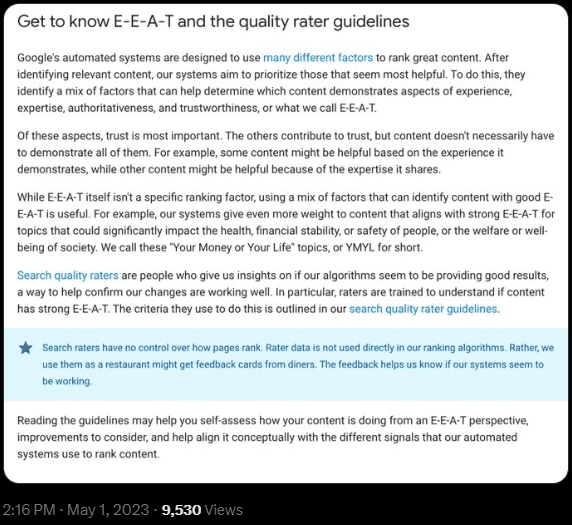
Google has added another E for Experience. E-E-A-T.
There are many great resources for a deep dive into E-E-A-T, and I recommend you do the “knowledge is power” thing. In this post, I’ll provide an overview of E-E-A-T to help you start reviewing your site and content.
I will update this post as new information and insights emerge. However, it is clear that it is time to embrace what is required to rank well; otherwise, you will never achieve this goal.
What Does E-E-A-T Mean?
Expertise, Authoritativeness, Trustworthiness (E-A-T), and now E-E-A-T, adding Experience on 12-15-22. [Read more here...] This is what Google SEO is all about.
Experience, Expertise, Authoritativeness, and Trustworthiness
Google’s Site Quality Rater Guidelines are a 176-page PDF document covering what Google site evaluators use in their determinations. Google updated it on September 11, 2025.
E-E-A-T is not part of the algorithmic ranking system. It’s a set of criteria for human evaluation. This is why I frequently discuss niches and branding. That’s what makes you stand out and supports your SEO efforts regardless of algorithms.
A Little History…
This is how sites have consistently been ranked for as long as I can remember, before an official ranking system was established. It’s just common sense: let the cream rise to the top.
However, we now have access to Google’s SEO documentation on the thought process involved, as well as another way to explain the variables you need to consider for your search engine rankings.
Discussions with John Mueller of Google:
Here’s what Google said in 2022
At the 10:30 mark. John Mueller of Google said that while Google doesn’t use an E-A-T score, E-A-T is still essential and is indirectly factored into the search ranking algorithm. Here’s the entire Office Hours video for your review:
Then, From the VP of Search at Google
E-E-A-T Summary
Experience
Consider the extent to which the content creator has the necessary firsthand or life experience relevant to the topic. Many pages are trustworthy and effective when created by individuals with extensive knowledge and expertise. For example, which would you trust more: a product review from someone who has personally used the product or a “review” from someone who has not?
Expertise
Are you knowledgeable on the topic of your site? This is where consistent effort to build your brand across platforms will pay off. That is why I emphasize crafting an engaging About Page for my clients; it strengthens their E-E-A-T story.
This is even more important if you run a YMYL site. “Your Money or Your Life.”
“YMYL” is mentioned 120 times in the Search Quality Evaluator Guidelines.
Pages that fall into YMYL are…
For YMYL topics, the reputation of a website should be judged by what experts in the field have to say. Recommendations from expert sources, such as professional societies, are strong evidence of a positive reputation.
GSQEG, 3.3.1 Reputation of the Website
Topics and Expertise
This doesn’t require an “official” expert, such as a lawyer or doctor with educational credentials. Life experience can indicate expertise, as “everyday experience.” Once again, the quality and volume of your content should back this up.
Pages that share first-hand life experience on clear YMYL topics may be considered to have high E-E-A-T as long as the content is trustworthy, safe, and consistent with well-established expert consensus. In contrast, some types of YMYL information and advice must come from experts.
GSQEG, 3.4.1 YMYL Topics: Experience or Expertise?
Authoritativeness
Is it clear who is creating the content? Does experience back up the content? Are you a credible source? (Or just a site churning out shallow or aggregated content to support all your ads?) Credibility depends not only on the content but also on external reviews and testimonials.
This also applies to your Author profile. List all your credentials and provide a detailed view, including accreditations and endorsements. Make clear why you are an expert on the topics you write about.
Trustworthiness
Can visitors easily trust the site creator, content, and overall quality? This includes security (HTTPS). Contact information, policy pages, and privacy statements also build trust.
The bottom line is that your website needs to be credible in every aspect, from visuals to content, context, and structure. Every little thing you do or don’t do can affect your E-E-A-T score.
“Human Work”
Added in October 2026: When reviewing content quality, Search Quality raters are trained to evaluate the main content’s fundamental attributes. The newest being:
For the full list, check out this page: Creating Helpful, Reliable, People First Content
FREE: Find new keywords for your market…

It’s All About High Quality
Back in the day, putting up your website produced results. With fewer websites, it was easier to be found. The bar wasn’t as high as it is today. Now, getting found depends on algorithms, AI-created results, and social media proof. Users and platforms determine your expertise, authority, and trustworthiness. And, boy, has that bar been raised.
If you think about it, you apply E-E-A-T principles every time you land on a new site, even subconsciously. Then you decide whether the information is credible and whether you’re willing to trust that site with your hard-earned dollars.
Quality and Satisfaction are Key
Shoot for high quality. Not average, not just enough. High quality.
Some say quality is in the eye of the beholder. But not when it comes to Google SEO. Your website, particularly its content, must effectively serve and satisfy that purpose.
Pages with the following characteristics should be considered Untrustworthy:
GSQEG, 4.5 Untrustworthy Webpages or Websites
Now, AI is even a consideration in E-E-A-T. Read: An AI-powered process to diagnose E-E-A-T issues. “As AI takes over search, E-E-A-T is how brands stay visible. Audit credibility gaps and position yourself as the choice AI recommends.”
Ask Yourself These E-E-A-T Questions
Now that you understand what constitutes a high-quality site, you know what to do to achieve it. First, review your main content, visuals, and navigation to ensure they are optimal for your site visitors.
You must do whatever you can to make your site zippy, too. This is just as important for Google SEO.
While updates and algorithms can impact your rankings, creating great content remains the ultimate key to success. However, no one will stick around for all that great content if your site hangs.
None of this is really “new” news. It’s the way sites have been judged from the start. Do you want to be viewed as an expert? Write like one — a lot. Do you want to be an authority on a subject? You’d better be, because you can’t fake it.
Want to get great rankings?
Identify your niche, build your brand, and target visitor intent, while keeping your site fast, visually appealing, user-friendly, and engaging. Trust takes time; there are no shortcuts. Trust is golden.
At your service,

